
When the Classroom Became a Parliament
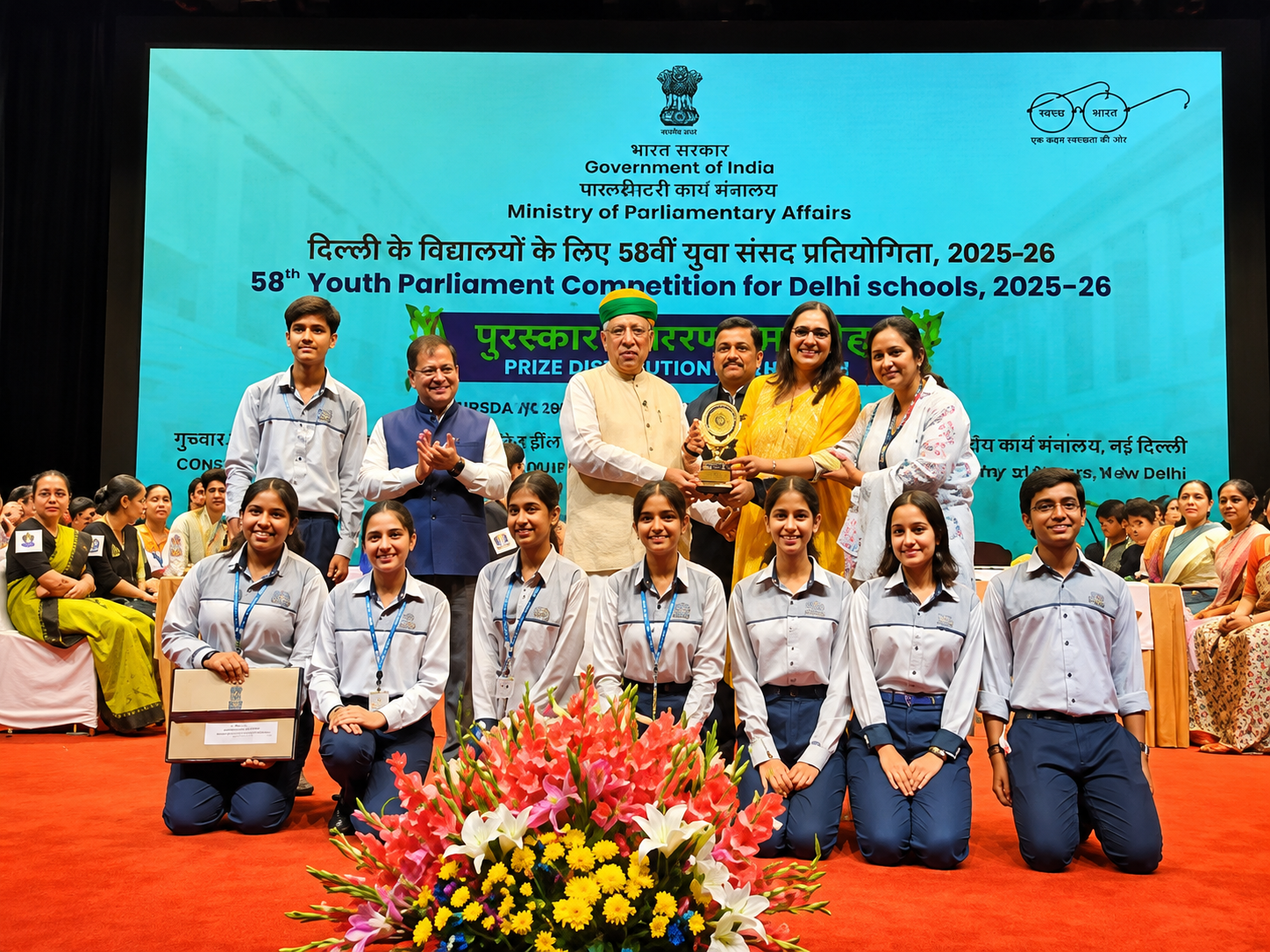
How students of Bal Bharti Public School, Pitampura, turned debate, dialogue and democratic thinking into a winning performance
A school classroom can be many things: a laboratory, a library, a playground for ideas. For the students of Bal Bharti Public School, Parwana Road, Pitampura, Delhi, it became something even more ambitious—a Parliament.
The students have emerged as the winners of the 58th Youth Parliament Competition 2025–26, organised by the Ministry of Parliamentary Affairs for schools under the Directorate of Education, Government of NCT of Delhi and the New Delhi Municipal Council. Their achievement was formally recognised at a prize distribution ceremony held at the Parliament House Complex in New Delhi on August 25, 2026.
What makes the achievement particularly relevant to the theme of Leadership and Debate is that this was not simply a competition in delivering memorised speeches. The Youth Parliament programme is designed to familiarise school students with parliamentary procedures, discussion and debate while developing self-confidence, leadership qualities and effective oratory.
A School Takes the Lead
Bal Bharti Public School achieved the top position in the 58th competition and was awarded the prestigious G.V. Mavalankar Running Parliamentary Shield and Trophy. The school also secured the trophy for standing first among new entrant schools—an especially notable accomplishment because it was competing as a new entrant in the programme.
The achievement placed the school's students on a national institutional stage. At the prize distribution ceremony, they were invited to present a repeat performance of their Youth Parliament sitting before an audience at the Parliament House Complex. Their performance was appreciated by those present.
For these students, therefore, the reward was not simply a trophy. It was the opportunity to demonstrate that young people can engage seriously with the language and practices of democracy.
Where Debate Becomes Leadership
There is an important difference between speaking and leading.
A good speaker can hold an audience's attention. A good debater can defend a position. But a leader must also listen to opposing viewpoints, understand different perspectives and respond without losing sight of the larger objective.
That is precisely why Youth Parliament programmes are valuable at the school level.
The Ministry's own description of the programme emphasises tolerance of diverse opinions, responsible expression of views and democratic values. Students are introduced to parliamentary procedures and the techniques of discussion and debate, turning abstract lessons about democracy into something they can actually experience.
For a student, standing up to present an argument is an exercise in confidence. Listening to another argument is an exercise in maturity. Negotiating between different views is an exercise in leadership.
The students of Bal Bharti Public School have demonstrated all three in a setting designed to mirror the country's democratic institution.
The Bigger Lesson Behind the Trophy
The Ministry of Parliamentary Affairs has been conducting Youth Parliament Competitions for schools in Delhi for around six decades. The longevity of the programme reflects a simple idea: democracy cannot be sustained merely by teaching its definitions in textbooks. It has to be experienced.
For school students, a simulated Parliament provides that experience.
It asks them to move beyond the familiar question, “What is the correct answer?” and towards more challenging questions: “What do I believe?” “Why do I believe it?” “Can I explain it?” “What does the other side think?” and “Can we find common ground?”
These are not merely debating skills. They are life skills.
More Than a Competition
It is tempting to look at Bal Bharti Public School's victory simply as another school achievement. But the significance lies deeper.
At a time when young people encounter an overwhelming amount of information and opinion every day, the ability to distinguish argument from assertion is becoming increasingly important. Students need spaces where they can question ideas, disagree respectfully and learn that changing one's position in the face of a stronger argument is not weakness—it is intellectual strength.
Youth Parliament gives them such a space.
And the success of Bal Bharti Public School shows what can happen when students are given the opportunity to take that responsibility seriously.
Tomorrow's Leaders Are Learning to Speak Today
The students who stood in the simulated Parliament at Bal Bharti Public School may not yet hold public office. They are not policymakers or elected representatives.
They are school students.
But leadership does not suddenly appear on the day a person enters a position of authority. It develops much earlier—in classrooms, on stages, during discussions and sometimes in the simple courage to stand up and say, “I have a different point of view.”
Bal Bharti Public School's victory is therefore more than a school trophy. It is a reminder that leadership begins with a voice—but grows through listening, reasoning and responsibility.
If today's students learn to debate ideas without dividing people, to speak with confidence without silencing others, and to lead without losing the ability to listen, then the classroom Parliament may be preparing them for something much larger than a competition.
It may be preparing them for democracy itself.