Saathvik: The Class 12 Student Using AI to Create an Innovative Solution for Epilepsy Care
Technology becomes truly meaningful when it is used to solve real-world problems. Saathvik, a Class 12 student with a strong interest in Artificial Intelligence and electronics, is emerging as a young AI innovator from India. His journey demonstrates how student technology innovation can transform a personal experience into an idea with the potential to create social impact.
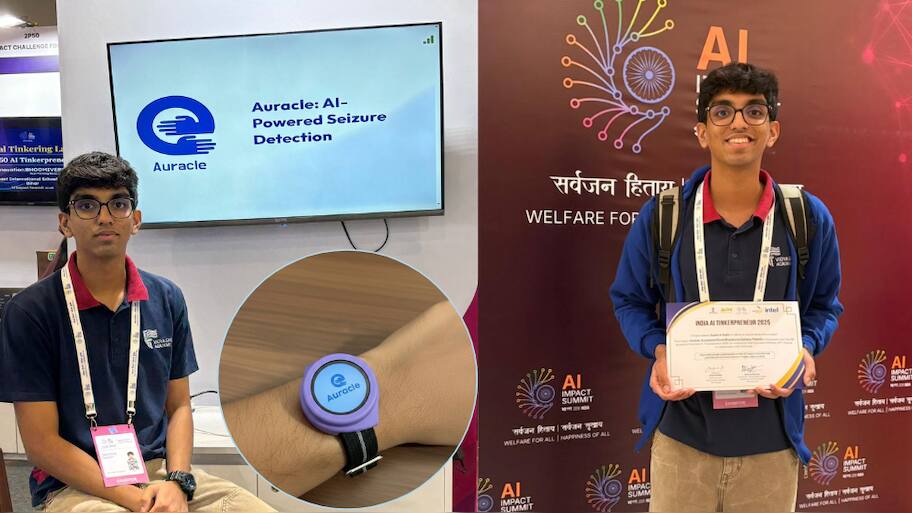
Through his Saathvik AI innovation, he developed Auracle, an AI-powered wearable device designed to help detect falls and seizure-related movement and provide timely alerts to caregivers. His journey from learning AI and electronics to developing an innovative healthcare solution highlights the potential of young Indian student innovators.
Saathvik's Early Life and Inspiration
Saathvik is a Class 12 student and a Thrissur native who was brought up in Bengaluru. His interest in technology developed alongside his experiences at home.
From a young age, Saathvik witnessed his mother's seizures and the difficulties that could occur when someone experiences a sudden seizure or fall. These experiences made him think about whether technology could provide additional support during such situations.
Rather than simply observing the problem, he began exploring ways to use technology to address it. This became the starting point of his journey as a young AI innovator.
Developing an Interest in Artificial Intelligence
To turn his idea into reality, Saathvik began learning about Artificial Intelligence, machine learning and electronics. He spent more than a year taking online courses and developing his technical knowledge.
His learning journey shows how school students can use online education and practical experimentation to build skills beyond their regular school curriculum.
For Saathvik, learning Artificial Intelligence was not limited to understanding concepts. He wanted to explore how AI could be applied to solve real-world problems.
This approach eventually led to his Artificial Intelligence student project, Auracle.
The Beginning of the Auracle AI Project
Saathvik started developing Auracle in May 2025. The project was created as an affordable wearable technology solution aimed at helping people with epilepsy.
The Auracle AI smartwatch uses sensors and AI-based technology to monitor movement and identify patterns associated with falls and seizures.
When the system detects a possible emergency event, it is designed to send an alert to an emergency contact through a connected smartphone.
The project represents an example of AI healthcare innovation by a school student, combining technology with a real-world need.
How Auracle Uses AI and Sensors
Auracle combines sensors with machine learning to monitor movement patterns.
The technology is designed to identify unusual movements that may indicate a fall or seizure. When a possible emergency is detected, the system can communicate the alert through a connected smartphone.
The purpose of the AI-powered wearable device is to provide faster awareness to caregivers during potentially dangerous situations.
Auracle is not intended to replace medical diagnosis or treatment. Instead, it focuses on providing an additional technological support system that could help families respond more quickly during emergencies.
Why Saathvik Focused on an Affordable Solution
Accessibility was an important part of Saathvik's student technology innovation.
While researching existing assistive technologies, he found that some similar devices could be expensive. This encouraged him to explore whether an affordable solution could be developed for users in India.
Saathvik and his family have estimated that Auracle could eventually be available at around ₹5,000 to ₹10,000, although the project remains under development and its patent is pending.
This focus on affordability makes his innovation particularly relevant to the concept of accessible technology for healthcare.
Learning Through Research and Mentorship
Developing an AI-based healthcare solution requires knowledge from multiple fields. Saathvik continued expanding his skills through research, online learning and mentorship.
He has been associated with Algoverse, a US-based machine-learning and AI research programme. He also collaborated with a biomedical implants researcher at the University of Oregon for mentorship.
These experiences gave the young innovator opportunities to understand how research and technology development work beyond the school environment.
For a Class 12 student using AI for healthcare, such exposure can be an important part of developing both technical and problem-solving skills.
Recognition for Saathvik's AI Innovation
Auracle received recognition through several platforms.
Saathvik was recognised as a National Winner of the India AI Impact Festival 2025 in the AI for Accessibility category. He also received the Future Port Youth Award in Prague and a Changemaker Award from Moonshot Innovators in the United States.
These achievements brought attention to his work as one of the young students exploring AI innovation in India.
The recognition also demonstrated how student-led technology projects can gain visibility when they focus on meaningful real-world problems.
Presenting His Innovation in 2026
Saathvik's AI innovation journey continued into 2026.
According to his public professional profile, Auracle was selected for presentation at the India AI Impact Summit 2026 in New Delhi.
The opportunity allowed him to showcase his project and interact with other innovators, researchers and technology professionals.
For a school student, participating in a major AI platform provides valuable exposure to the wider technology ecosystem and offers opportunities to learn from experts working in the field.
Saathvik's Present Journey
Saathvik continues to explore Artificial Intelligence, machine learning and emerging technologies while completing his Class 12 education.
His interests extend beyond Auracle. His public professional profile also mentions AI research involving Large Language Models (LLMs).
This shows that his interest in technology is continuing to grow beyond a single project. His journey is gradually moving from learning fundamental concepts to exploring more advanced areas of Artificial Intelligence.
As he approaches the next stage of his education, his experience in AI research, electronics, innovation and mentorship provides a strong foundation for future opportunities.
From a Personal Experience to a Technology Innovation
What makes Saathvik's story different is the personal motivation behind his AI healthcare innovation.
Auracle was not created simply as a school competition project. The idea developed from seeing a real challenge faced by someone close to him.
That experience encouraged him to learn new technologies, understand the problem and experiment with possible solutions.
His journey demonstrates an important lesson for students: innovation can begin by observing a problem and asking how technology can help solve it.
Inspiring Young Indian Student Innovators
Saathvik's story shows that students do not have to wait until college to explore advanced technology.
School students can begin learning Artificial Intelligence, coding, electronics, robotics and machine learning through online resources, educational programmes and practical projects.
His journey from a Class 12 student interested in technology to a young innovator developing an AI-powered wearable device demonstrates what curiosity, learning and experimentation can achieve.
For other young learners, his experience can serve as motivation to explore their own ideas and develop technology-based solutions for problems around them.
The Future of Saathvik's Innovation Journey
Saathvik's journey is still developing. Auracle remains a technology prototype, and further research, testing and development will be important as the project progresses.
From starting the Auracle project in 2025 to receiving recognition and presenting his innovation in 2026, Saathvik has already built an impressive foundation as a young technology innovator.
His story shows how a Class 12 student using AI to solve a real-world problem can turn curiosity into innovation.
As he continues his education and explores new areas of Artificial Intelligence, his journey will be one to watch in the growing community of young innovators in India.
Conclusion
Saathvik's story is an inspiring example of student innovation in technology. His experience demonstrates how personal challenges can lead to creative ideas and how learning Artificial Intelligence can help students explore solutions to real-world problems.
Through Auracle, his AI healthcare innovation, Saathvik is exploring how wearable technology and Artificial Intelligence could provide additional support to people living with epilepsy.
His journey from a curious school student to a recognised young AI innovator reminds us that innovation has no fixed age. With curiosity, continuous learning, mentorship and determination, young students can begin creating solutions that have the potential to make a meaningful difference.